Historic Austin
Visit Austin’s historic late 19th and early 20th century houses, schools and churches, and meet...

For most Chicagoans, O'Hare is simply a place to catch a flight. Architecturally, it tells a much larger story.
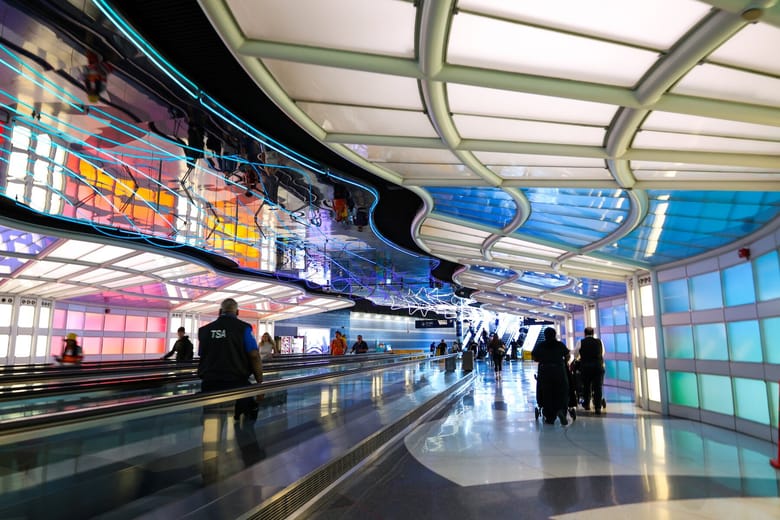
Underground Pedestrian Walkway at O'Hare International Airport. Photo by Emmely Aldave.
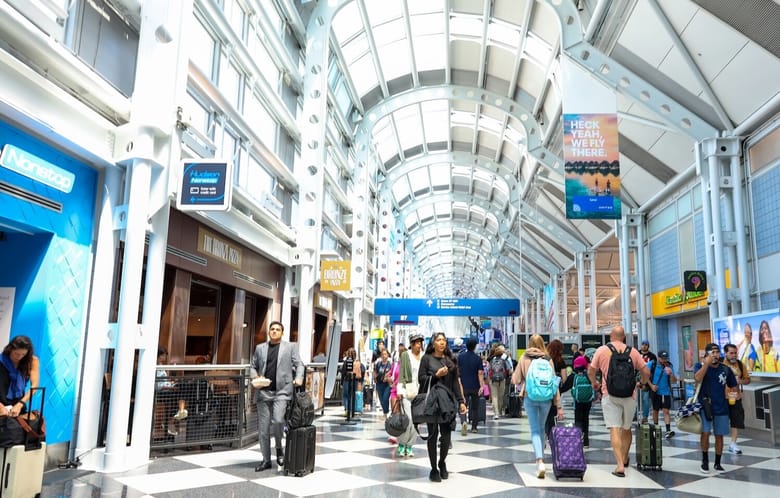
Terminal 1 at O'Hare International Airport. Photo by Emmely Aldave.
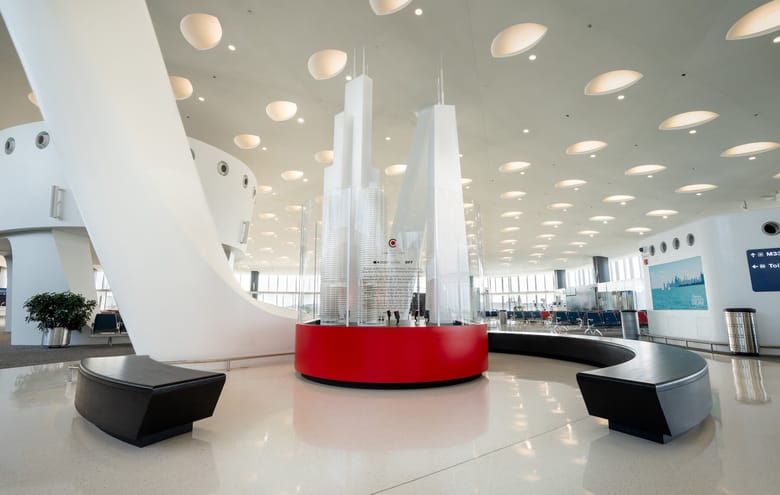
"Icons of Chicago", a CAC exhibition in Terminal 5 at O'Hare International Airport. © City of Chicago.
Official Name | O'Hare International Airport |
Address | 10000 W. O'Hare Ave |
Architect | |
Style | |
Neighborhood | O’Hare Community Area |
Current Use Type |
Since opening in the 1950s, O'Hare has repeatedly redefined what an airport can be. It helped establish the blueprint for the modern jet-age airport, became home to one of Chicago's most celebrated airport terminals and is now undergoing the largest transformation in its history.
Located on the Northwest Side, O'Hare is both a transportation hub and a showcase of architectural ideas. Over the last seven decades, its buildings have reflected changing attitudes toward transportation, technology and civic identity.
When O'Hare opened as Chicago's primary commercial airport in the 1950s, it was unlike anything that had come before. The site was originally a German American farming community known as Orchard Place. During World War II, it became a manufacturing center for the Douglas Company’s C-54 Skymaster aircraft. After the war, the property was converted into Orchard Field Airport. Its connection to the Douglas Aircraft Company is the reason the airport still carries the ‘D’ in the airport code, ORD.
Airport planners anticipated a dramatic increase in air travel following World War II. To handle this growth, they introduced several forward-thinking ideas, including a centralized terminal system that allowed passengers to move efficiently between ticketing and boarding areas while keeping aircraft operations at a distance. Today, this approach feels obvious, but it represented a major shift in airport planning.
O'Hare also incorporated a number of innovations that would become standard at airports around the world, including underground fueling systems, passenger loading bridges and direct connections to highways and public transit.
The investment in the airport reflected the optimism of postwar America, confidence in technology and the growing possibilities of air travel. Before long, O'Hare had become one of the busiest airports in the world and a symbol of Chicago's role as a national transportation hub.
While O'Hare's original terminals helped define how a major international airport could function efficiently, Terminal 1 reimagined what the airport experience could feel like.
Completed in 1987 by Chicago architect Helmut Jahn, Terminal 1 rejected the low ceilings and enclosed spaces common in many airports of the time. Instead, Jahn took inspiration from the great train stations of the early twentieth century, creating soaring halls filled with natural light. Expansive glass walls and exposed steel give the structure a sense of openness and movement. Jahn viewed O'Hare as more than a place to pass through. He saw it as an experience.
One of Terminal 1's most memorable spaces is the underground pedestrian tunnel connecting Concourses B and C. Moving walkways carry travelers through an immersive environment of curving, colorful, backlit walls and kinetic light displays. Above, Michael Hayden's Sky's the Limit transforms the 744-foot-long tunnel into a multimedia experience, featuring a neon installation synchronized to George Gershwin's Rhapsody in Blue.
Today, Terminal 1 remains one of the airport's defining architectural landmarks and one of Jahn's most widely experienced works.
Decades after its last major expansion, O'Hare entered a new era with the launch of the O'Hare 21 program. The largest expansion project in the airport's history includes two new satellite concourses, expansions to Terminals 2 and 5, additional gates and lounges, and upgrades to operations across the entire airport.
A centerpiece of the project is the transformation of Terminal 2 into the new O'Hare Global Terminal (OGT). Designed as an alliance-based hub, the terminal will bring domestic and international operations closer together, making transfers between flights more seamless for passengers. The Studio ORD team — comprised of firms including Studio Gang, Solomon Cordwell Buenz (SCB), Corgan, STL Architects, and Millhouse Engineering — was selected to design the project.
In many ways, the proposal builds on Helmut Jahn's belief that airports should be destinations rather than mere transportation facilities. Designers have sought to make the terminal feel more like a Chicago neighborhood, incorporating references to the Chicago River, the ‘Y’-shaped Municipal Device, and the iconic four-star city flag. Gardens, retail spaces, public amenities and gathering areas are intended to create an experience that extends beyond travel itself.
Few airports have had as much influence on architecture and transportation planning as O'Hare. Its original facilities helped establish the framework for modern airport design, Helmut Jahn's Terminal 1 demonstrated that airport buildings could be both highly functional and architecturally ambitious and today, the O'Hare 21 expansion is positioning Chicago once again at the forefront of airport design.
Together, these eras tell the story of an airport that has continually reinvented itself while shaping how millions of people experience air travel. And if history is any guide, this will not be O'Hare's last chapter.

O'Hare Airport is named for Edward "Butch" O'Hare, a Chicago-born naval aviator and the U.S. Navy's first flying ace of World War II. In 1942, he single-handedly shot down five enemy bombers attacking his aircraft carrier, earning the Medal of Honor.
Planners once considered using Meigs Field as a primary downtown link to O'Hare. Passengers would board small planes at the lakefront airport and fly across the city to catch connecting flights. Instead, O'Hare was designed with direct highway and rail access.
Butch O'Hare's father, Edward O'Hare, was a businessman with close ties to Al Capone. He cooperated with federal investigators in cases that contributed to Capone's downfall. In 1939, he was killed in a gang-style shooting, an “unsolved” murder often linked to his break with organized crime.
Tucked inside the airport grounds, Rest Haven Cemetery predates O'Hare itself. Rather than move it, planners simply built the airport around it.
In 1966, the Federal Aviation Agency hired I. M. Pei & Associates to design a new air traffic control tower at O’Hare.
Prior to C.F. Murphy Associates taking over the project in 1956, the airport’s design was led by Ralph Burke, a city engineer who developed a master plan for the airport before passing away in 1956.